Despite billions in planned water investments and leaning on support from both USAID and the Chinese private sector, residents of the northern Nigerian state face unreliable supplies, potential contamination, and serious health risks.
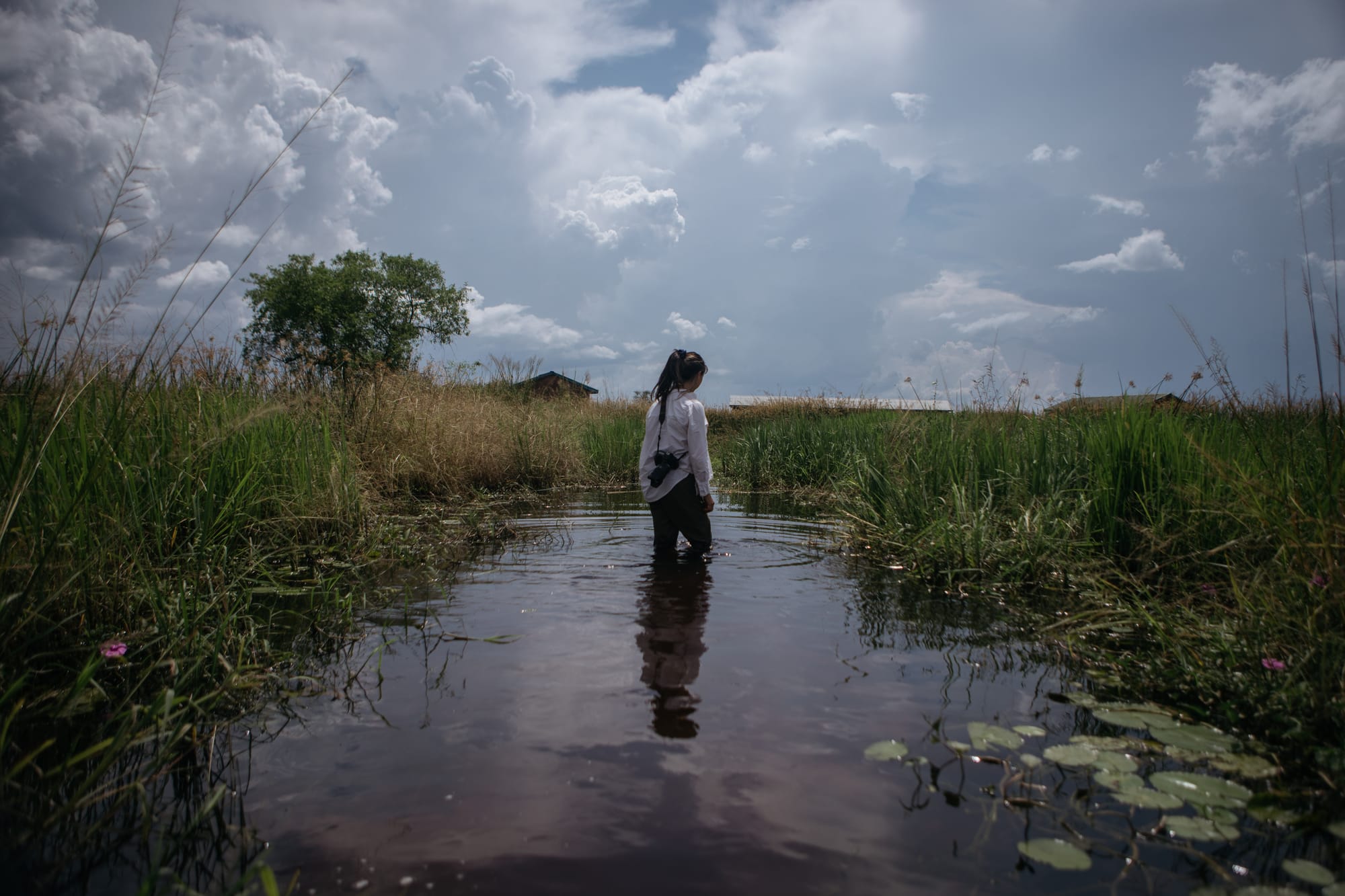
Based in Nairobi, Kenya, Kang-Chun Cheng 鄭康君 covers environmental change, cultural continuity, foreign interventions, and outdoor adventure. She has reported for us from some of the most inaccessible locations on Earth, including war-torn Ukraine and South Sudan (pictured).
NANYUKI, Kenya – When her teenage son did not return home on the night of June 9th, Lucy Kagure assumed he had stayed the night with his grandmother.
She had told 17-year-old Sylvester Muigai Ndung’u to stay away from the town centre of Nanyuki, a gateway town to Mount Kenya with a thriving tourism economy, where protests had engulfed the streets against a proposed Ebola quarantine facility. Protesters clashed with the police, leaving five people — including two police officers — injured and 50 protesters arrested. So far, three people have been killed in two demonstrations against the planned facility, according to Armed Conflict Location & Event Data (ACLED), an organization that tracks political violence and protests worldwide.
The tensions came after an Ebola outbreak in Ituri, a province in the northeastern Democratic Republic of Congo, or DRC, which the World Health Organization declared a “public health emergency of international concern.” Ten days later, news that a quarantine facility would be built in Nanyuki for Americans exposed to the virus in Africa sparked criticism across Kenya, with many questioning why it was being built over 700 miles from the outbreak’s epicenter.
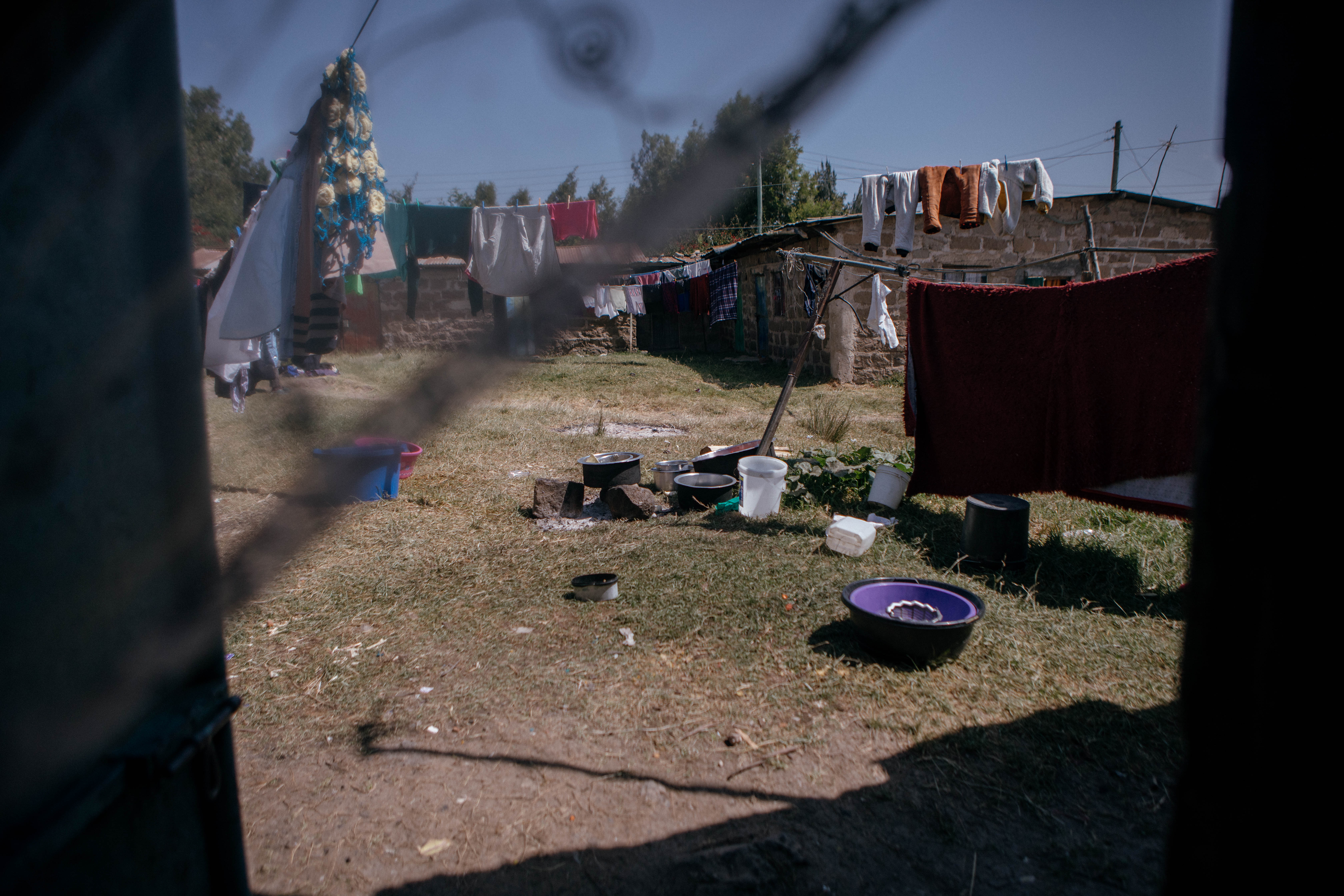
View from the one-room corrugated shack where Lucy Kagure lives in Nanyuki. (Kang-Chun Cheng/The Xylom)
“We’re still under a colonial system,” said John Maigua, an activist with the Defenders Coalition in Nanyuki. "Imagine building an Ebola facility in a country where there are no cases.”
By the following morning, Sylvester’s continued absence left his mother anxious. When she began searching for him, officers at the local police station dismissed her, telling her that she “wasn't a good mother.” She went from one hospital to another before making a final stop at the morgue.
There, she found Sylvester’s body wrapped in a shroud, waiting to be identified.
Sylvester had been shot dead at the protest, with evidence of police brutality that the local police denied. An autopsy ordered by the Independent Police Oversight Authority and the Independent Medico-Legal Unit found that a bullet entered above his left eye and lodged in the back of his brain.
John Maigua, an activist with Defenders Coalition in Nanyuki. (Kang-Chun Cheng/The Xylom)
Ebola spreads through direct contact with the bodily fluids of an infected person. Symptoms include fever, fatigue, vomiting, bleeding, and severe dehydration, and it has an average fatality rate of about 50%.
The 50-bed Ebola quarantine facility, allegedly designed to “maximize patient outcomes” and expected to be manned by American medical staff, was being set up through a “coordinated effort” between the U.S. State Department, the U.S. Department of Health and Human Services, and the Pentagon.
The U.S. promised a $13.5 million commitment toward Kenya’s Ebola preparedness. There is currently no information on whether the money will go towards preparedness measures or the quarantine facility.
Kenyans did not respond to the facility positively. The High Court of Kenya held Health Minister Aden Bare Duale in contempt for ignoring multiple orders issued in late May and early June to block construction plans for the quarantine facility. The Katiba Institute, a Kenyan human rights group, argued that the lack of public consultation rendered this facility illegal.
Yet, at first, construction pressed ahead. Kenyan President William Ruto stated that it would be “very inhuman” for Kenya to reject a US-funded health facility after years of receiving American aid.
Nanyuki in Kenya’s Laikipia County is the gateway to Mount Kenya, Africa’s second-highest peak. Plans for an Ebola quarantine facility here triggered widespread protests despite Kenya having no Ebola cases. (Kang-Chun Cheng/The Xylom)
“It shows that our president doesn’t respect the Constitution,” Maigua said. “There was no public participation on this matter. Our government did not even announce news about this facility to us. We found this out from social media.”
In 2015, the U.S. and Kenya signed a biosecurity agreement which created a legal foundation for cooperation on biosecurity threats and outbreak response. However, the agreement also granted the U.S. certain privileges regarding health interventions in Kenya, including tax exemptions for American workers. The agreement was renewed in 2022.
“No one wants to go on holiday near an Ebola [quarantine] facility. No tourism means joblessness and insecurity, and then people have to find other ways to make a living." — a Nairobi-based researcher.
Opaqueness behind such projects fuels public apprehension and distrust toward the government, Maigua said. “There’s no information, nothing. We don’t know how they are disposing of waste — what if a stray dog carries something with Ebola contamination to the community?”
On June 23rd, Duale appeared before the court, saying that the government had halted construction of the facility. Yet, many remain concerned about the future and goals of the quarantine facility.
Let's Go to the Ends of the Earth.
Subscribe to The Xylom's free newsletters to get more dispatches from our Editor-at-Large.
No spam. Unsubscribe any time.
“We’re told this will be staffed by Americans and will be for Americans, but the government is telling us that after Ebola is finished, it will help bolster the Kenyan medical system,” said a researcher based in Nairobi, whose name is withheld due to security concerns. “What are we supposed to think?”
The dearth of accurate information from the Kenyan government has also led to speculative misinformation filling the gaps.
“There’s talk that the [American] Ebola facility is built to facilitate the smuggling of critical minerals from DRC to Kenya,” Maigua said. “There aren’t any people on the ground in Ituri to share what is happening — maybe there isn’t even any Ebola.” [I interjected, citing the work of journalists who have reported from the ground, affirming that Ebola cases are real.]
The controversy over the quarantine facility triggered protests, legal challenges, and, ultimately, the untimely death of Kagure’s son.
The local Catholic Church helped Kagure with Sylvester’s burial costs. “When my son was killed, no one [from the government] pretended to send condolences; there was no representative at his funeral,” Kagure recounted. “Not even during burial preparations, because they are afraid to be viewed as anti-government.”
Lawyer Derrick Maingi, a human rights activist and founder of Sheria Mashinani, a community-based legal training organization, said that families such as Sylvester’s should not be given token payments.
“They are entitled to full, dignified, and meaningful reparations where investigations establish that the death or injury resulted from unlawful state action, police excesses, or failure by the State to protect life,” Maingi said.
The Catholic church in Nanyuki, where Sylvester served as an altar boy before his death. (Kang-Chun Cheng/The Xylom)
According to Maingi, someone such as Kagure would have a constitutional claim against the State. Yet, Kenya currently lacks such a compensation scheme. A special ad hoc committee has been drafting a new piece of legislation since last summer, after at least 38 people were killed during the July 7 protests, held to commemorate the historic Saba Saba pro-democracy movement.
To Maingi, Uganda, a neighboring East African country, serves as a regional example through its Human Rights (Enforcement) Act. “[The Act] gives courts a clearer framework to enforce human rights remedies and even contemplates personal accountability by public officers who violate rights. Kenya should go further and create a victim-centered framework that is transparent, prompt, and enforceable.”
Kagure had encouraged her son to pursue a career in the Catholic Church to gain future economic stability. “He was a good boy,” she said, speaking from the one-room mabati (corrugated) shack where she and her three remaining children live. A stray chicken clucks from the top bunk of a bed. “He was an altar boy and wanted to become a priest. He made me so proud.”
Kagure continues to hope for justice after her son’s death. “The American government, especially the president, is also to blame for Sylvester’s death. If it weren’t for their idea, this wouldn’t have happened.”
The Xylom's reporting is supported by hundreds of readers like you. Becoming an annual or monthly member is the best way to help us maintain a steady source of revenue that supports investigations that span months, if not years. Cancel anytime.
“Why is America coming to Kenya, just because [President William] Ruto is given money by the U.S. government?” she continued. “Why can’t the facility be in America?”
.Mwangi Ndirangu contributed to this reporting from Nanyuki.
JULY 6TH UPDATE: This article has been updated to reflect an increase in the number of arrests and to include additional information on protest-related deaths.
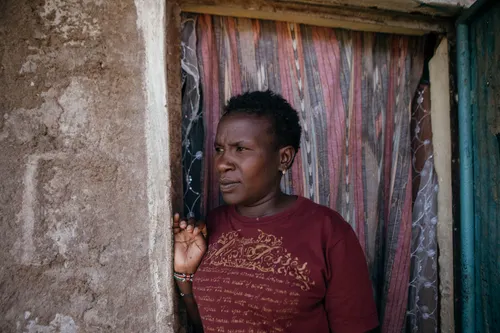
Lucy Kagure, 36, lost her 17-year-old son, Sylvester Muigai Ndung'u, after police opened fire during protests over a proposed Ebola quarantine facility in Nanyuki on June 9th. (Kang-Chun Cheng/The Xylom)
The American government’s decision to build an Ebola quarantine facility over 700 miles away from the outbreak sparked protests, legal concerns, and the untimely death of a teenage boy.
Protesters believed that Kennedy, who has frequently promoted baseless conspiracy theories about the safety of mRNA vaccines, influenced the CDC shooter, Patrick Joseph White, who blamed the COVID-19 vaccine for his depression and suicidal ideations.
In an interview with Healthbeat days before the rally, many CDC workers expressed fears that the ongoing multipronged attack on public health would make the country less safe and its healthcare more expensive.
“We planned this protest many months ago before the attack on [the] CDC even happened,” said Aryn Backus, an organizer with Fired but Fighting, a coalition of current and fired HHS employees. “But after [Patrick Joseph White] fired 500 rounds at the CDC because he believed in misinformation about the COVID-19 vaccines, we felt it was even more important to come out and protest because it’s not just the budget cuts. It’s the misinformation and the lies that Secretary of Health and Human Services Robert F. Kennedy Jr. is spreading.”
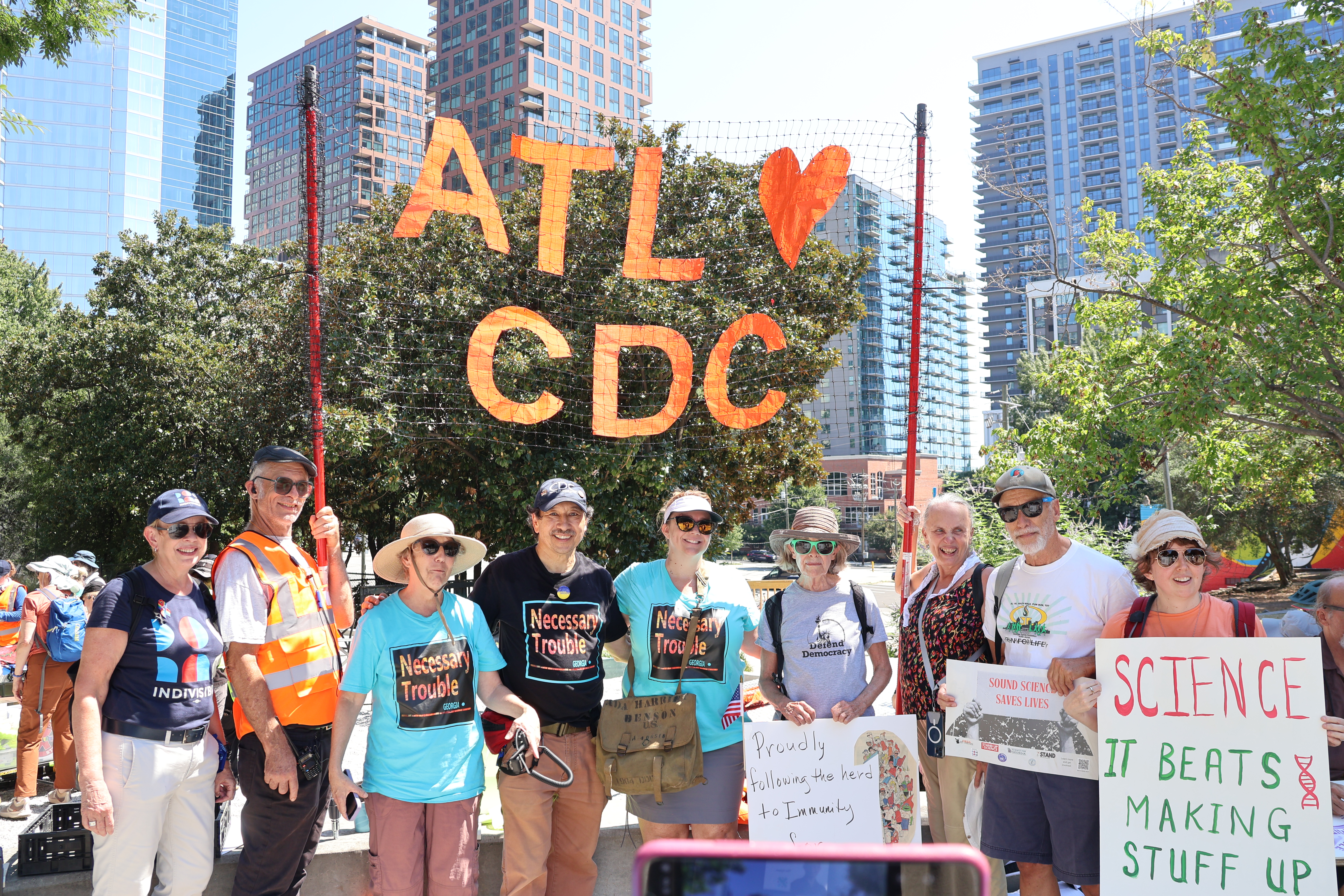
Organizers hold up a large “ATL ♥️ CDC” banner at the “Sound Science Saves Lives” rally in Atlanta, August 16th, 2025. (Alex Ip/The Xylom)
Before Backus was terminated from her position as a health communication specialist at the CDC’s Office of Smoking and Health in February, she worked on programs such as the Tips from Former Smokers campaign, which showcases stories for people who have been affected by smoking. Her office also had strong existing partnerships with the Asian Smokers’ Quitline, which offers services and resources in Cantonese, Mandarin, Vietnamese, and Korean, in addition to Smoke Free Chinatown, which did events in Chinatowns across the U.S. to promote anti-smoking messages.
Backus is worried about the future of public health programs serving Asian Americans. “The Asian Smokers’ Quitline receives a lot of funding from the CDC; with the Office of Smoking and Health gone, we’re not sure if that Quitline will be able to fill in the funding gaps that the CDC left.”
Let's Dig Deep Together.
Subscribe to The Xylom's free newsletters to get more collaborative, in-depth coverage of how Trump and friends are making the world poorer, sicker, and dirtier.
No spam. Unsubscribe any time.
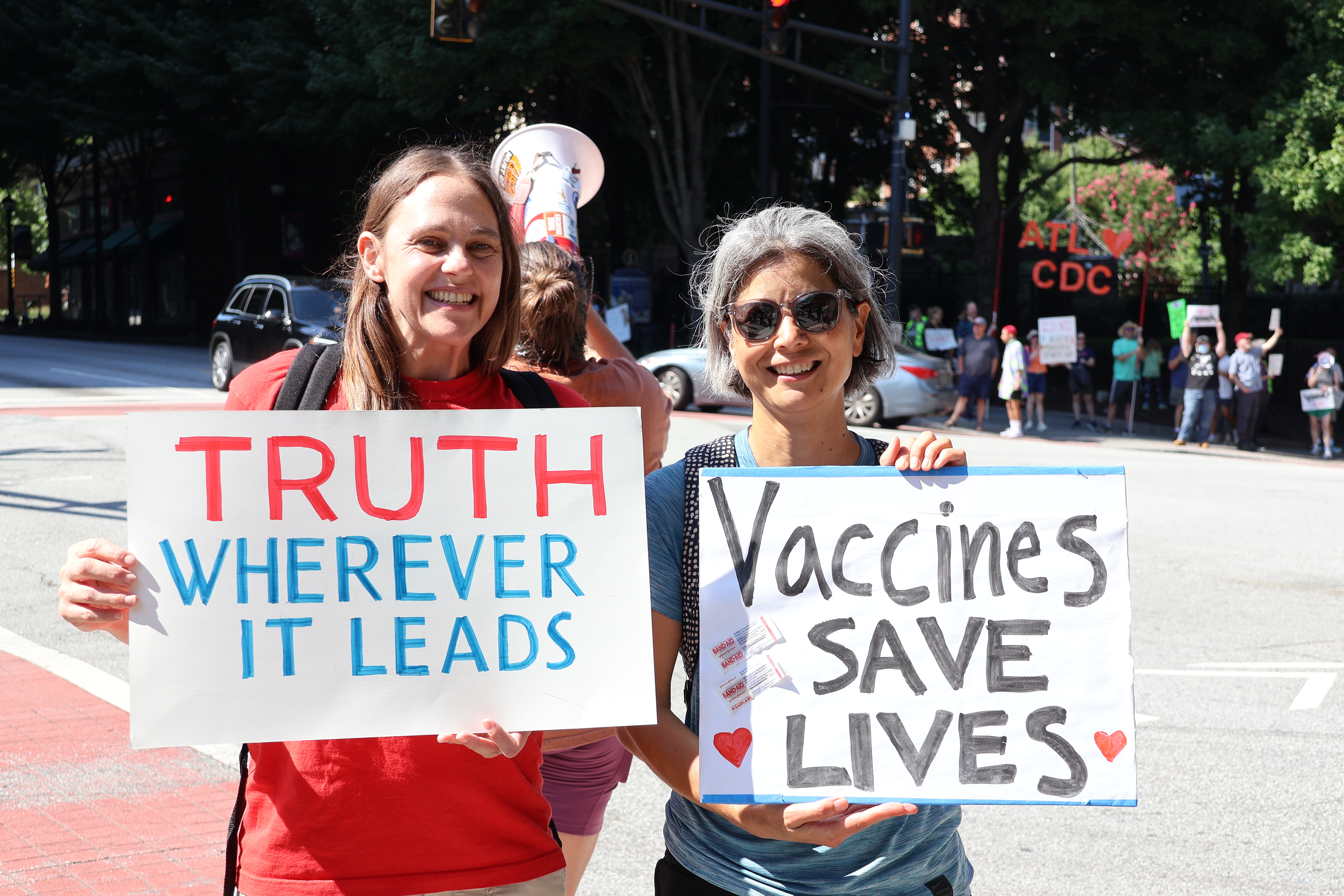
Organizers estimated the total number of protesters to be roughly 300-500. Apart from fired CDC workers like Backus, other attendees included researchers, health professionals, labor organizers, and concerned citizens.
Dr. Irene Yang is a Korean American and Canadian registered nurse. She is also a health researcher who looks into oral health and its relationship to the rest of the body. Although she emerged unscathed from funding cuts, many of her colleagues were not as fortunate.
“Constant cutting of good science is eventually just gonna erode all of the progress that we made in terms of disease treatments and interventions and public health,” she said.
Dr. Jill Penn agrees with Yang’s sentiment. An Associate Professor of Biology and Biochemistry at Georgia Gwinnett College and Treasurer of United Campus Workers Southeast, a union that represents all the higher education employees in the Southeastern United States, she serves one of the most diverse counties in the country, including the largest Asian population by far in the state of Georgia.
Dr. Jill Penn (left), a biology professor, poses with a fellow attendee of the “Sound Science Saves Lives” rally in Atlanta, August 16th, 2025. (Alex Ip/ The Xylom)
“A lot of my students are applying for graduate school and professional programs; many of them have done all the right things [...]their four or five years of college,” she said. “And then they apply to do something that they’ve loved their entire life, working in the field of science, and all of a sudden it just doesn’t exist anymore.”
“It’s like the world’s been turned upside down. It’s unrecognizable from what this country was one year ago,” she lamented.
As with previous public rallies around science, public health, and democracy, Atlanta Mayor Andre Dickens, and Atlanta City Councilmembers, who are up for reelection this November, are absent. (The qualifying period for Atlanta municipal elections begins Monday, Aug. 19th.) Although many of the protesters’ signs evoked the late Rep. John Lewis, his successor, Rep. Nikema Williams, did not attend any of the rallies either.
However, two suburban Democratic candidates vying for statewide office in 2026, Georgia Sens. Jason Esteves and Josh McLaurin, joined protestors.
“We need state leaders to stand up and fight for our public health workers and to protect them from what is nothing short of domestic terrorism,” said Esteves, who is aiming to become the first Afro-Latino to be elected Governor of Georgia.
The Xylom's reporting is supported by hundreds of readers like you. Becoming an annual or monthly member is the best way to help us maintain a steady source of revenue that supports investigations that span months, if not years. Cancel anytime.
Running on a platform of recruiting healthcare providers who are from those communities they serve, fully expanding Medicaid, and establishing clinics all across the state, Esteves faces a crowded primary field that includes former Atlanta Mayor Keisha Lance Bottoms, former DeKalb County CEO Michael Thurmond, and Georgia Rep. Derrick Jackson, among others. (McLaurin is currently unopposed in the Democratic primary for Lieutenant Governor.)
The rally wrapped up peacefully at around noon without any incidents or counterprotests. Participants vow to keep fighting and voicing their opposition.
“I think a lot of times scientists might want to just put their head down and try to do what they can within their sphere. I think it’s really important for us as Americans to speak up and speak out,” said Yang. “I hope my fellow Asian Americans, whether they’re in science or healthcare, will also speak out. I know that they recognize the danger.”
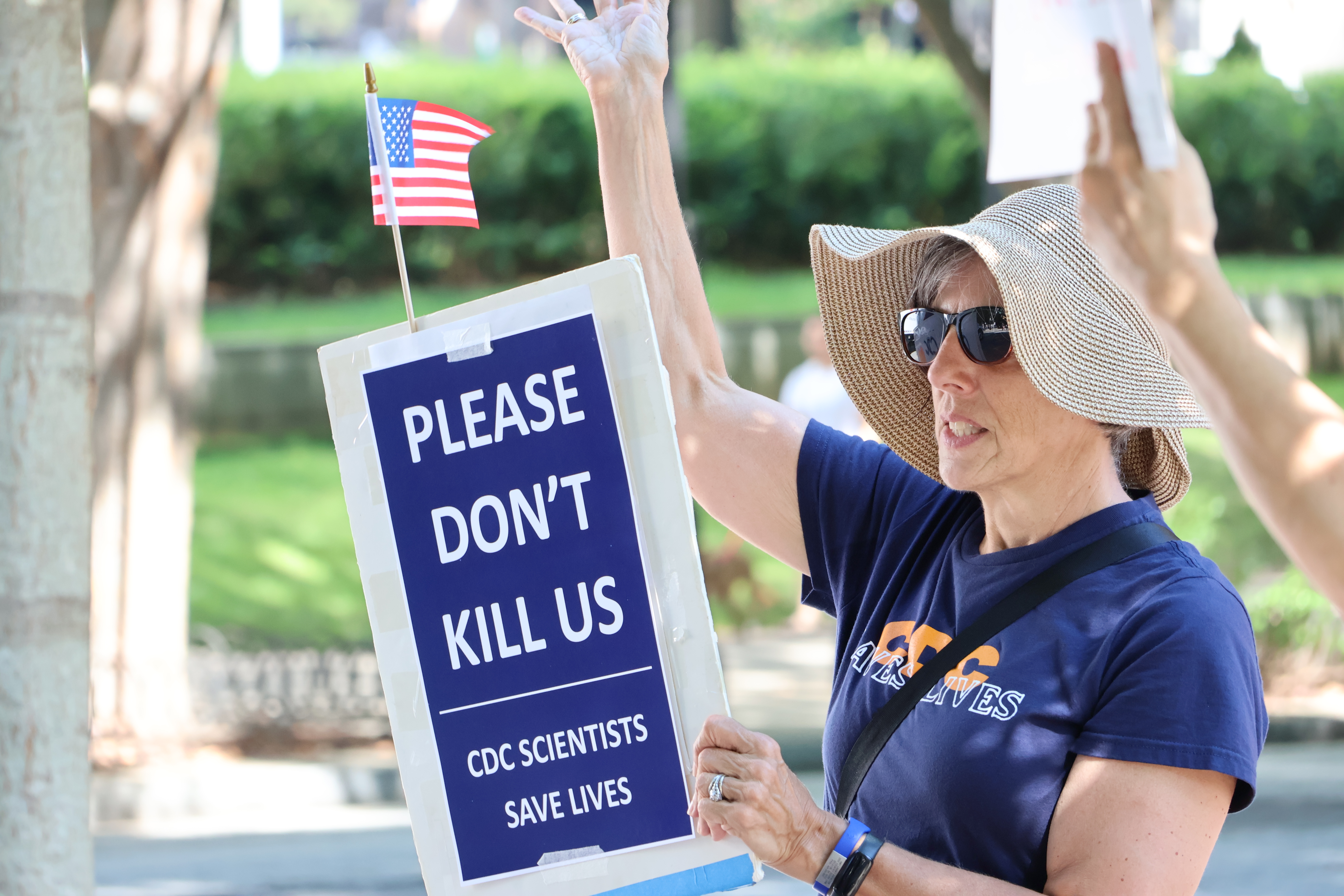
A protester holds up a large “PLEASE DON’T KILL US” sign at the “Sound Science Saves Lives” rally in Atlanta, August 16th, 2025. (Alex Ip/The Xylom)
Atlantans Sound Alarm Over Federal Cuts, Misinformation, Deadly CDC Shooting
Rooftop solar promises to thread the needle, taking advantage of Hong Kong’s dense, vertical landscape to provide clean, reliable, affordable energy.
What's (Not) Working?
Get more updates on the world’s most ingenious public health and climate solutions.
No spam. Unsubscribe any time.
“Solar energy is a green source of electricity, and I can earn income from it,” said Yintung Cheung.
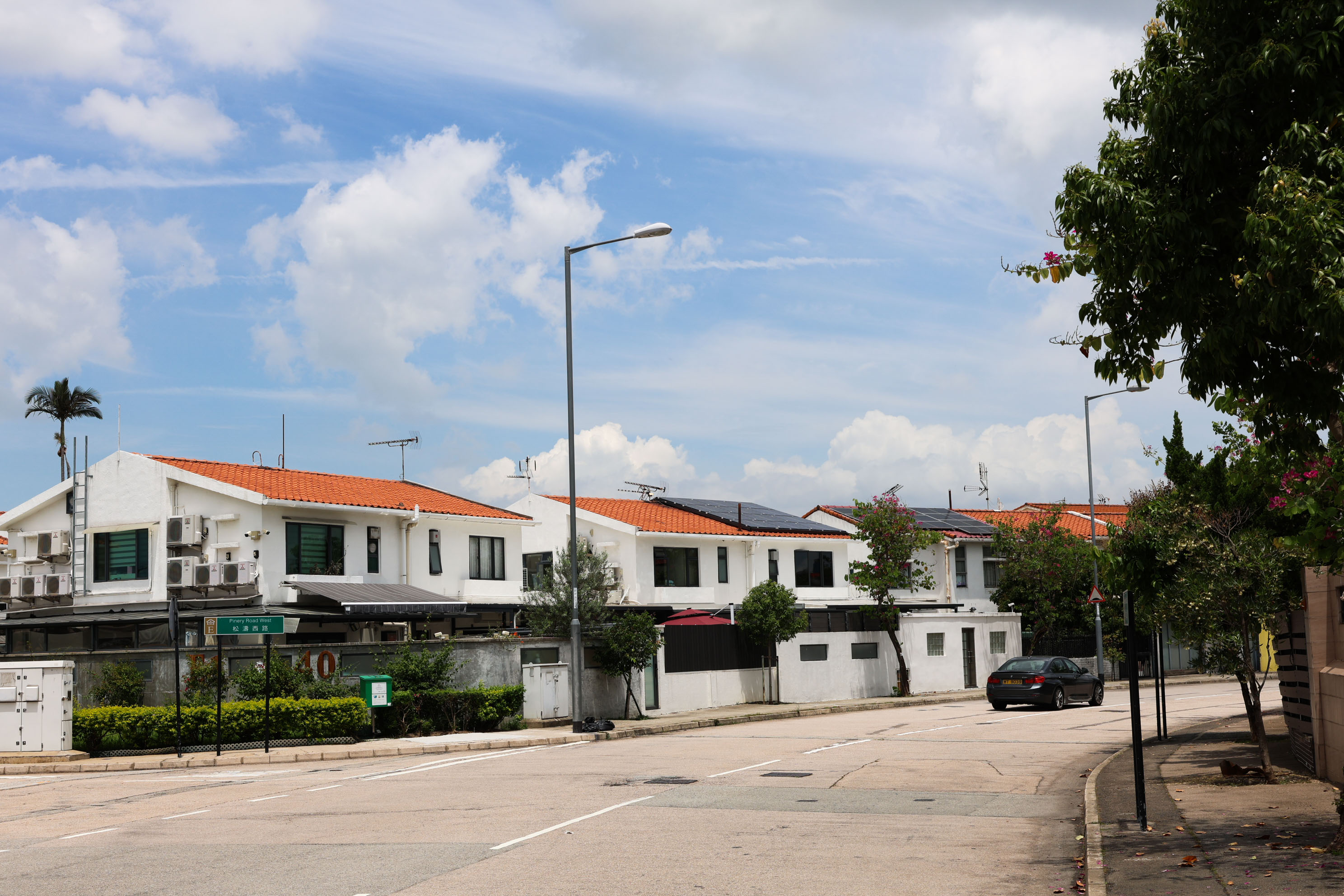
A former elementary school teacher, Cheung is now a fundraising consultant who counts Greenpeace and the World Wildlife Fund among his former clients. He is a resident of Fairview Park, a suburban gated neighborhood in the northwestern New Territories, just a stone’s throw away from the Shenzhen border. Of the 5,000 semi-detached houses in the sprawling development, a rarity in the city, roughly one-tenth of them are equipped with solar power systems.
Yintung Cheung in front of his house at Fairview Park. (Alice Chuck for The Xylom)
Residents, schools, and non-government entities have been actively installing rooftop solar systems since the government introduced fifteen-year financial incentives via the Feed-in Tariff (FiT) Scheme in 2018. Those living in detached houses, like Cheung, have been especially keen: The solar panels reduce air-conditioning use by insulating rooftops, cooling room temperatures by up to 5˚C (9˚F) if properly installed. It took Cheung less than four years to recoup the cost of his own 20kW solar power system; had the FiT Scheme not existed, it would have taken him three decades.
Yet, according to the most recent data released by the Hong Kong government, less than 0.5% of the city’s electricity came from solar energy. At the halfway point of the FiT program, Hong Kong’s solar energy production still lags behind most developed countries or regions, clocking in at a quarter of the levels of Singapore, a region of comparable population density and solar irradiation.
“I’m sometimes disappointed that the government is not being intentional about increasing renewable energy use. They only take the low-hanging fruit of importing electricity from Mainland China,” said Cheung.
How Does the Scheme Work?
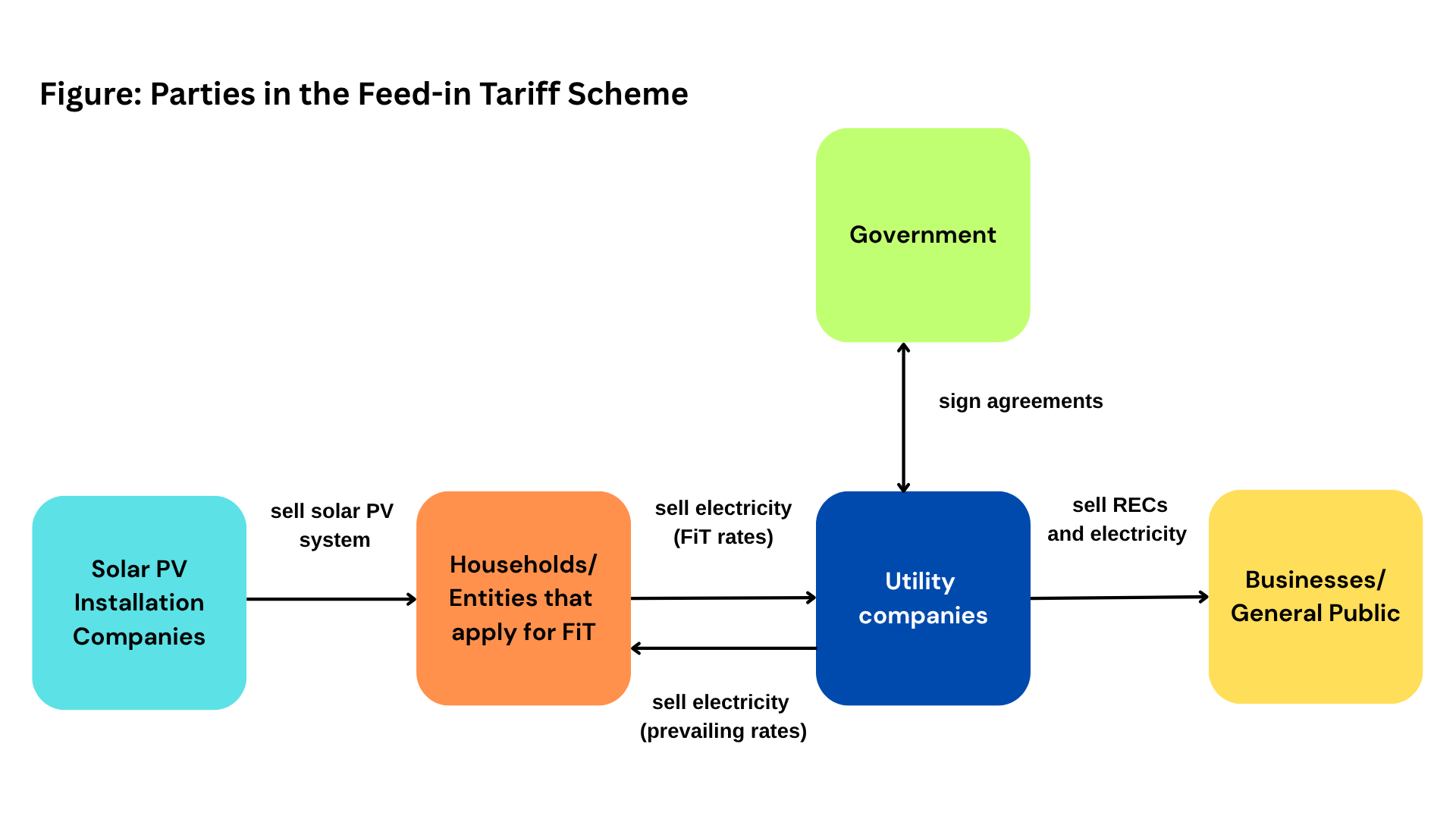
Under the Scheme, from 2018 to 2033, individuals or non-governmental bodies can sell solar or wind-generated electricity to utility companies at rates higher than what utility companies charge customers, with the highest FiT rates being granted in small, household-scale systems (≤10 kW) to compensate for economies of scale. This means that those who install solar on their rooftops can use it as a source of income, paying only the prevailing rates for their electricity consumption (around $0.13/kWh).
Unlike similar Biden administration-funded rooftop solar programs in the United States, the program is not means-tested, and there is no annual quota. Because the electricity generated from solar panels goes directly into the grid, Cheung also doesn’t need to install batteries and replace them every few years.
The Hong Kong government has signed decade-long agreements with two shareholder-owned utility companies, CLP Power and HK Electric, with options to extend the agreements for an additional five years. The recent agreements have included the FiT Scheme and reduced the companies’ profit margins from 9.99% to 8%, far below the average of 10.62% requested by American power companies.
To offset part of the cost, the utility companies can sell renewable energy certificates to buyers (such as banks) who wish to claim their businesses or activities are carbon-free. The utility companies are also allowed an extra profit margin for renewable energy produced by them or their customers.
Selena Liang for The Xylom
In the ten years before 2018, only 200 non-governmental renewable energy systems were connected to the grid. Since then, as of March 2025, around 26,800 FiT applications have been approved, and around 25,000 systems have been connected to the grid. Most applications are for solar energy systems, and more than 80% of applications are for small-scale systems — mainly in detached houses.
In the ten years before 2018, only 200 non-governmental renewable energy systems were connected to the grid. Since then, as of March 2025, around 26,800 FiT applications have been approved, and around 25,000 systems have been connected to the grid.
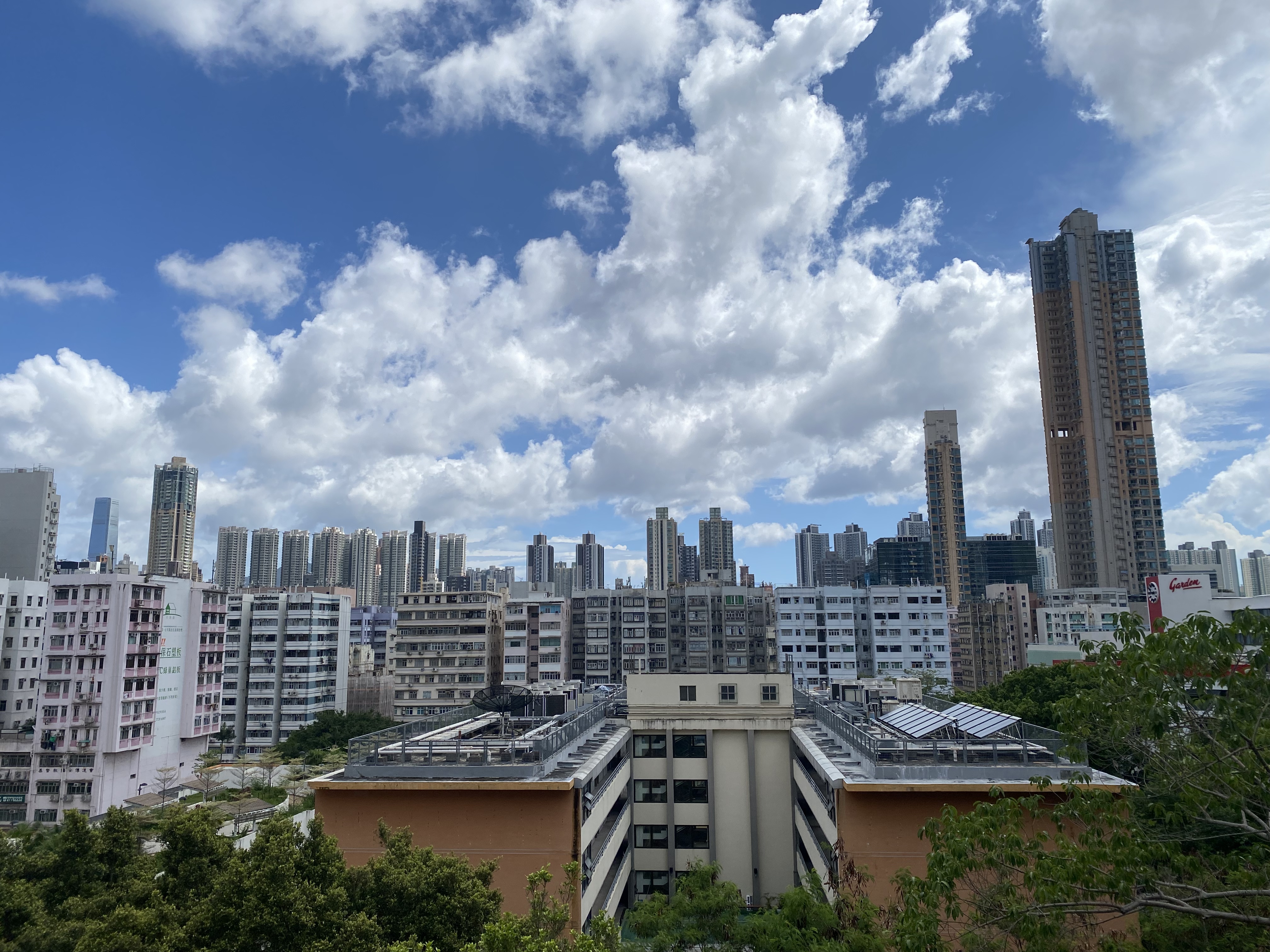
Installing solar panels in high-rise apartment buildings or commercial buildings often faces more challenges compared to those in detached houses. For one, high-rise rooftops often have practical functionality.
“In Hong Kong, most rooftops have already been occupied by facilities such as equipment rooms, pipelines, outdoor air-conditioning units, suspended platforms, landscaping, recreation spaces, and fire refuge areas,” a spokesperson of the government’s Electrical and Mechanical Services Department told The Xylom.
The other challenge is shade: tall buildings cast long shadows that block sunlight from reaching solar panels of nearby buildings. Integrating solar panels into the facade and external walls of a building, known as building-integrated photovoltaics, has not been widely applied either, due to cost and administrative concerns.
Mei Ho House (foreground) was built in 1954, and is the last remaining first-generation public housing block in the city. The historic building has been revitalized as a youth hostel with rooftop solar panels. (Selena Liang for The Xylom)
That said, data obtained from the government’s Environment and Ecology Bureau by The Xylom shows that although nonresidential entities completed less than a fifth of total FiT applications, they have installed half the capacity of solar power under the scheme. In 2024, the government launched a pilot scheme on transparent building-integrated photovoltaics at its Electrical and Mechanical Services Department offices to explore the relevant applications.
Schools and non-profits also benefit from the FiT Scheme. By installing solar panels on roofs, these organizations can earn income to cover part of the electricity fees or enhance environmental education.
“We are a Catholic school; by default, we should be an environmentally friendly school and be good stewards of this planet. We touch on environmental issues in our science and religious classes. We thought it would be great to promote climate education through installing solar panels,” said Sammy Shum, principal of Aberdeen Technical School.
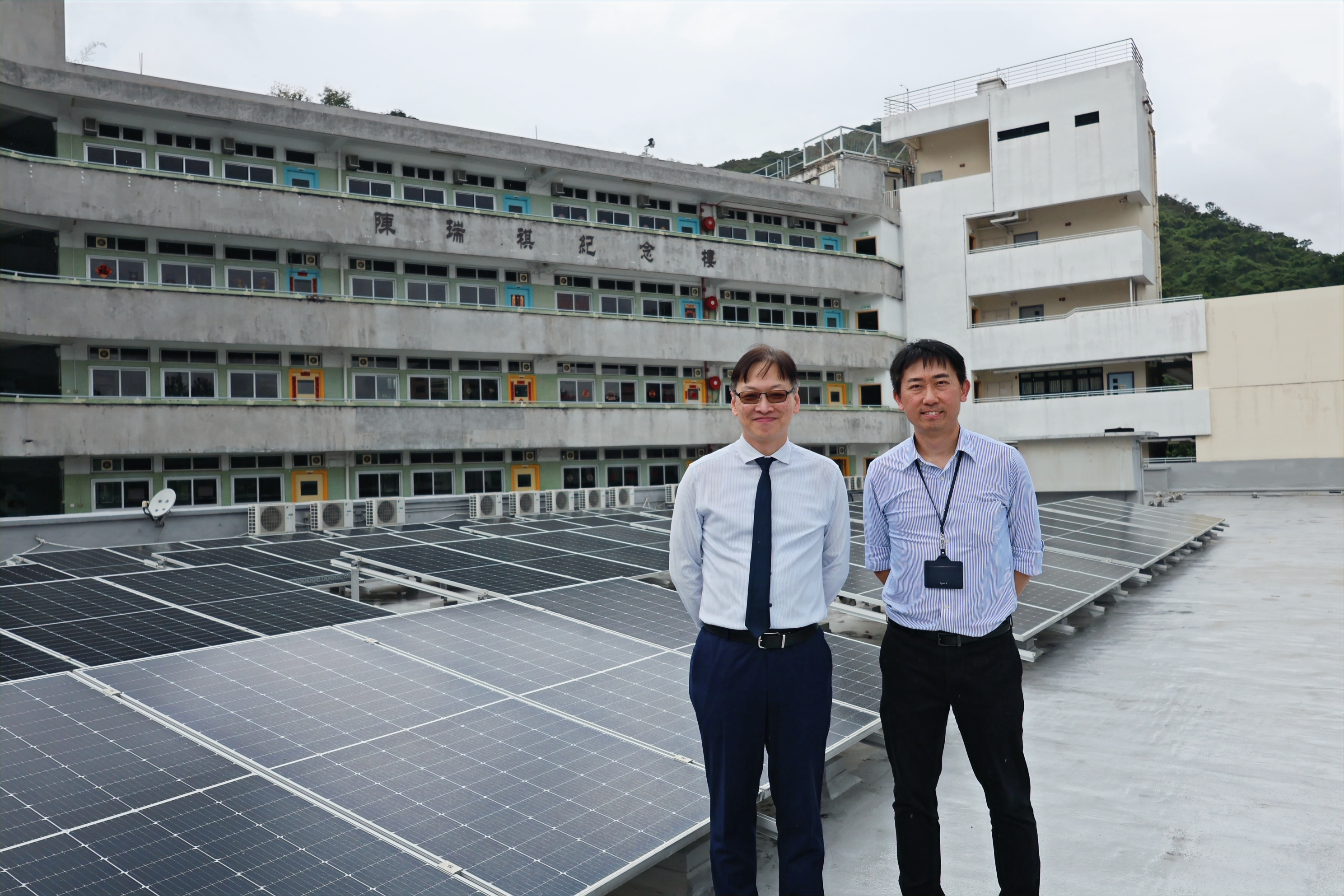
Sammy Shum (left) and Tsang Chi Yeung (right) at Aberdeen Technical School. (Alice Chuck for The Xylom)
The school has installed a 44 kW solar PV system on its historic campus, which meets the annual average electricity demand of 11 households. FiT earnings are used for education, such as training students to introduce guests to the school’s solar power system and the power generation mechanisms behind it.
Technical Challenges and Additional Costs
Despite its benefits, the FiT Scheme is no silver bullet. Residents, experts, and organizations interviewed for the story told The Xylom that the first barrier to widespread solar power adoption is the technical, financial, and administrative challenges during the installation process.
The first major concern is to determine whether a building is structurally sound enough to support solar panels. The main building of Aberdeen Technical School just turned 90 years old this year.
“Some members of our management committee were alumni, who became very concerned about our campus’s Grade III historical building designation. Would [the solar panels] affect its appearance? Would there be liability issues?” Shum said. The Aberdeen Technical School had to test the loading on the roof before making the decision.
“We are a Catholic school; by default, we should be an environmentally friendly school and be good stewards of this planet.”
The second major concern is potential roof leaks. At first, fixing the solar panels on the roof required drilling directly through the roof, which would result in leaks if the holes were not properly sealed. Some installation companies later improved their installation methods, but Cheung, the fundraising consultant and homeowner, still recommends waterproofing before installing solar PVs, especially in aging buildings. (Cheung himself spent nearly $8,000 on waterproofing, amounting to nearly a fifth of the total installation costs.)
The Xylom is an independent nonprofit. We have no owners or shareholders, no corporate interests, and no government contracts. We have no paywalls. Everything we publish is free. Join our community of members and cancel anytime.
Shum said Aberdeen Technical School spent between $500,000 and $640,000 on waterproofing — more than twice what the school receives from the government for building upkeep and maintenance.
“We were thinking, should we spend three years on waterproofing before installing solar panels?” Shum said. Fortunately, the Education Bureau helped the school advance a few years of its repair and maintenance funds to cover the waterproofing cost. After two years of preparation and communications with the government’s Antiquities and Monuments Office, the solar panels were finally installed.
Residents in particular face challenges in upgrading their power systems and finding reliable installation contractors. Most households in Hong Kong, as well as light commercial customers, receive electricity through a single-phase system using one live wire and one neutral wire. However, to make 10 kW or larger solar power systems viable, customers must upgrade to a three-phase system that uses three live wires and allows for a more efficient and consistent delivery of electrical power.
“If you only have single-phase power, you can only install a 2-3 kW system. That is not worth the investment,” said Kent Fung, the owner of a solar power system installation company and a Fairview Park resident. Not only would a smaller 2-3 kW system not cover the whole roof or provide heat insulation, but there would be minimal installation savings in terms of prevailing wages.
“You will need more than 10 years to recover the costs,” he added.
Kent Fung at Fairview Park. (Alice Chuck for The Xylom)
With the latest technology, Fung said the work of changing to three-phase power could be done mainly outside the house and would cause little nuisance indoors. However, the additional six to nine months, as well as the high cost of up to $6,000, could become a source of dispute between customers and contractors.
Compared to residential consumers, schools and NGOs receive more governmental and expert support in handling technical issues.
“I do not feel burdened as we received help from [CarbonCare InnoLab staff]. If I have to do it myself, I will find it difficult and my teaching time reduced,” said Tsang Chi Yeung, a teacher of Aberdeen Technical School.
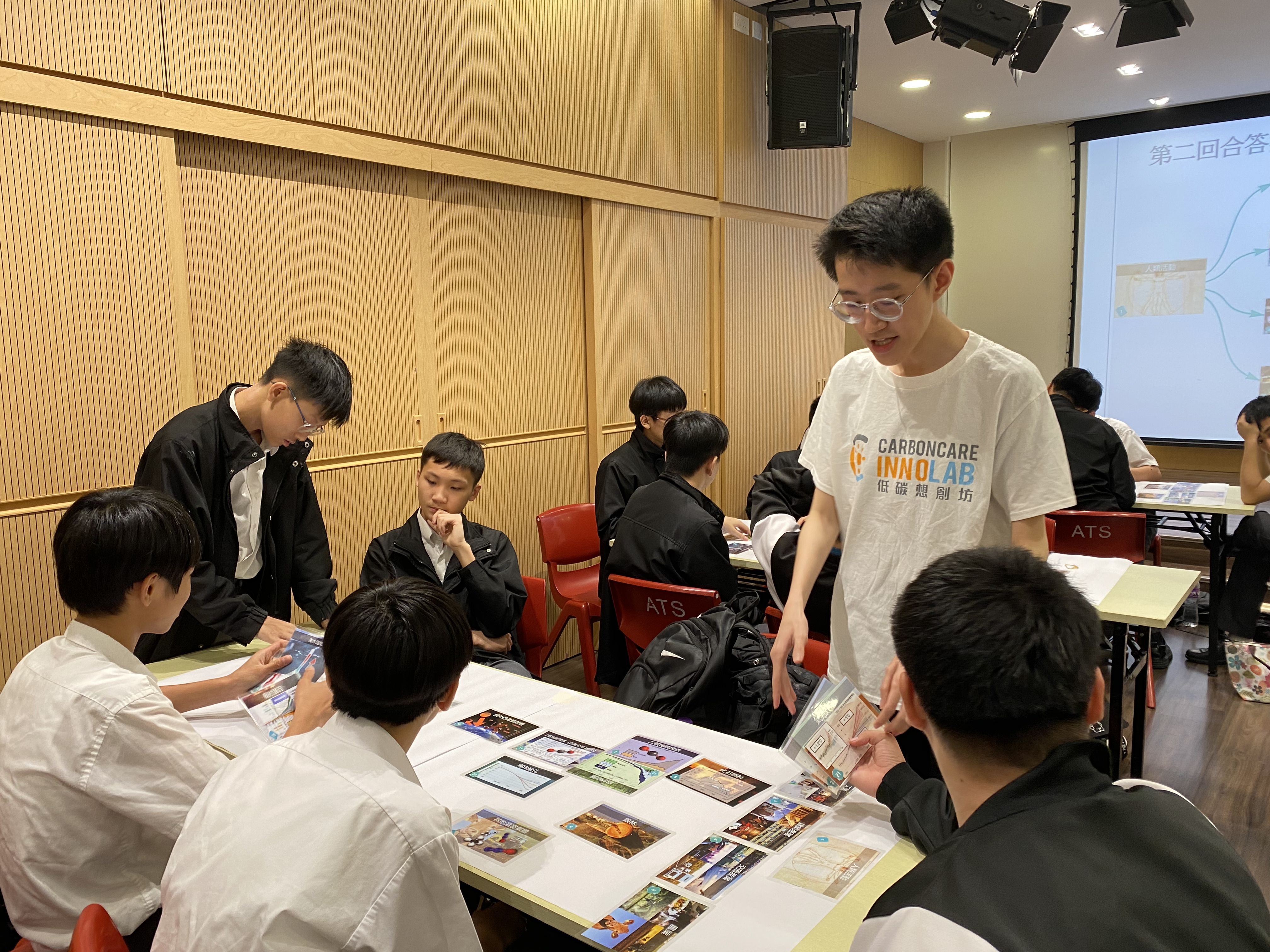
CarbonCare InnoLab is one of the nonprofits that helps schools and other NGOs install solar PV systems. The organization not only helps with the application process and maintenance, but also holds climate education activities for the school.
Carboncare InnoLab staff conduct a climate card game activity at Aberdeen Technical School. (Selena Liang for The Xylom)
“We place a great emphasis on [our multi-pronged strategy] on educating the public and young people on climate,” said Ivy Leung, Executive Director of CarbonCare InnoLab. “We have a lot of solar system tours. We hope schools and members of the public can understand the mechanisms of solar PVs and how they can help with Hong Kong’s 2050 carbon-neutral goal.”
What Happens When the Scheme Weakens?
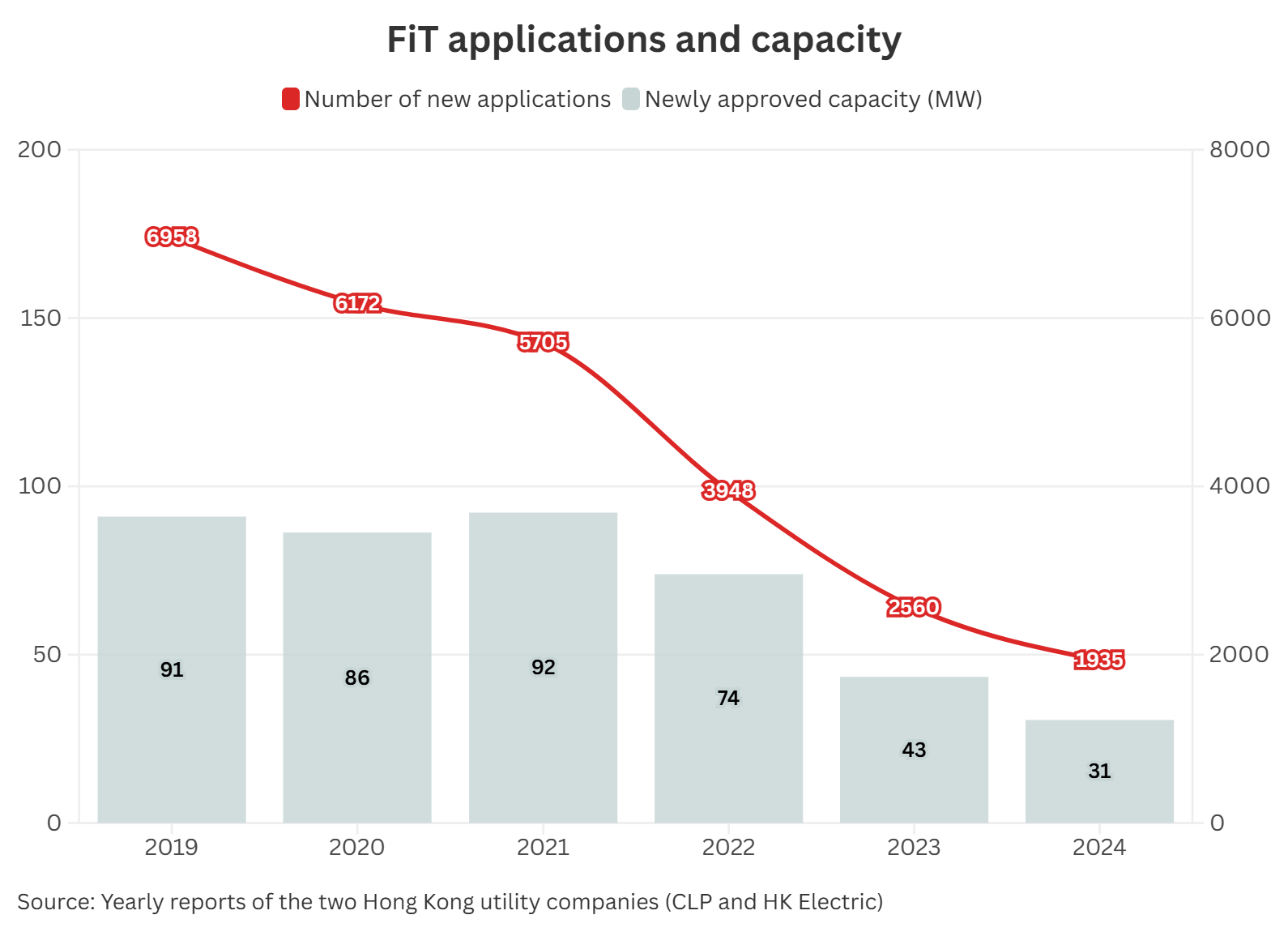
Publicly available data from utility companies revealed that the number of new applications has cratered since 2022, when the Hong Kong government lowered FiT rates as previously planned. It further declined when the Hong Kong government concluded the Solar Harvest Scheme, which provided one-stop services for solar installations in schools and NGOs, in 2024.
Selena Liang for The Xylom
Cheung thought at the time these lowered rates were reasonable, as the original intent of the scheme was to allow residents to recover their costs within seven to ten years of installation, while solar technology became cheaper as the technology matured. In reality, Fung, the solar panel installer, found that the price of a 10 kW system installation has remained stable over the years, at around $19,000.
“The price of solar panels has dropped slightly, but that of other components, such as inverters, has gone up. Wages have gone up, too,” he said.
“Even if you had a highly efficient system [like mine] that could recover the cost in three to four years, the real amount of time you could earn income if you installed now is at most another three to four years, and that doesn’t factor into the risks of system breakdown,” Cheung said.
Items
Cost (in USD)
Installation cost
19,000
Waterproofing (if needed)
4,000
Changing to three-phase electricity (if needed)
4,000-6,000
Maintenance cost (per year)
410
Replacing the inverter (every 5-15 years)
1,300-2,500
FiT earnings (per year)
-6000
Table: Lifetime costs of a 10 kW solar power system
In response to The Xylom’s enquiry, the Environment and Ecology Bureau countered that Hong Kong’s FiT rate “was still one of the most attractive in the world” when compared to local power rates.
“As renewable energy technologies are maturing, the trends in China and the world are to gradually reduce and cease subsidies for renewable energy,” said a spokesperson from the Environment and Ecology Bureau. They added that Hong Kong’s FiT Scheme would “unlikely” be extended beyond 2033. If that were to happen, owners of renewable systems could use the electricity generated for their own consumption.
Cheung and Fung agree that as the FiT program nears its halfway point, the lack of clarity about what happens after 2033 is a big factor that prevents people from installing solar PVs.
Subscribe to The Xylom’s Free Newsletters
Get more updates on the world’s most pressing health and environmental disparities.
No spam. Unsubscribe any time.
“No one knows what the plan is after 2033,” Cheung said. “Will the utility companies buy electricity from me at prevailing rates? Or should I buy storage batteries? That’d be wasteful.”
Cheung points to the United States’ regulatory and policy uncertainty as a cautionary tale:
“[Democrats] are supportive of solar energy, so a lot of these facilities were built. The moment [Republicans] replace them and support oil and gas development, all these solar panel investments […] go down the drain,” he lamented.
On August 5th, The New York Times reported that the Trump EPA announced plans to claw back $7 billion in grants for solar energy, including the “Solar for All” program in Georgia, where The Xylom is based, and one of six states Trump flipped in the 2024 Presidential election. (500 households registered for a randomized drawing in the 24 hours since its application portal opened on August 4th.)
The Path Ahead
At present, Hong Kong’s electricity mix consists mainly of natural gas (55.5%), nuclear energy (less than 24.5%), and coal (20%). Renewable energy only accounted for 0.8% of the electricity mix as of 2022.
Although a government-commissioned study in 2019 estimated that Hong Kong’s rooftop solar energy can at most account for 1.1-2% of its electricity use at 2016 levels, experts at the Hong Kong Polytechnic University estimated that rooftop solar PVs alone could account for more than 10% of Hong Kong’s electricity use, meeting the Hong Kong’s Climate Action Plan 2050’s goal of increasing the share of renewable energy in the electricity mix to 7.5% to 10% by 2035, the first step to reaching carbon neutrality by 2050.
WHAT's WORKING
El Paso solar cooperative helps homeowners save thousands on rooftop solar. It may be back next year.
Several nonprofits are running a solar cooperative in El Paso, Texas, that helps homeowners come together to buy and install solar panels in bulk, which makes them more affordable.
Fung, who has been running his small solar installation business since 2018, said that as solar panels can insulate rooftops from the sun and act as canopies for the roofs of detached houses, some residents are still interested in installing panels despite lower financial returns. But hesitance remains in the market, and customers are dwindling: his company lost money last year after turning a profit in the previous two.
“No one knows what the plan is after 2033.”
With the trend of decreasing FiT installations, even the most optimistic projections won’t see Hong Kong reaching the modest target of generating up to 2% of electricity from solar power by 2035.
“We really hope the government can look at the pace of renewable energy development in Hong Kong before deciding when to stop the Feed-in Tariff Scheme,” Leung of CarbonCare InnoLab said. She urged the government to provide more flexibility in the Feed-in Tariff Scheme, such as offering longer-term contracts for new installers, instead of setting a hard sunset provision in 2033.
The Xylom's reporting is supported by hundreds of readers like you. Becoming an annual or monthly member is the best way to help us maintain a steady source of revenue that supports investigations that span months, if not years. Cancel anytime.
In Fairview Park, Cheung has actively promoted solar PVs to his neighbours. He said residents share information on company pricing, new technologies, and maintenance, and help ease one another’s concerns. In the street where his house is located, 13 out of 30 houses have installed solar panels. However, he is not holding out hope for a meaningful energy transition in Hong Kong.
“If the government doesn’t have policies that go hand-in-hand [with residents and businesses], and it chooses to sunset the FiT program instead,” Cheung said, “Hong Kong won’t have a shot at meeting renewable energy goals.”
Houses at Fairview Park. (Alice Chuck for The Xylom)
Reporting for this story was supported by Internews’ Earth Journalism Network.
Rooftop Solar Power Is Struggling to Take Off in Hong Kong. What Went Wrong?
For the past six decades, CPC has served Asian Americans, immigrants, and low-income communities in the United States through various programs such as after-school classes, family support, and economic empowerment programs.
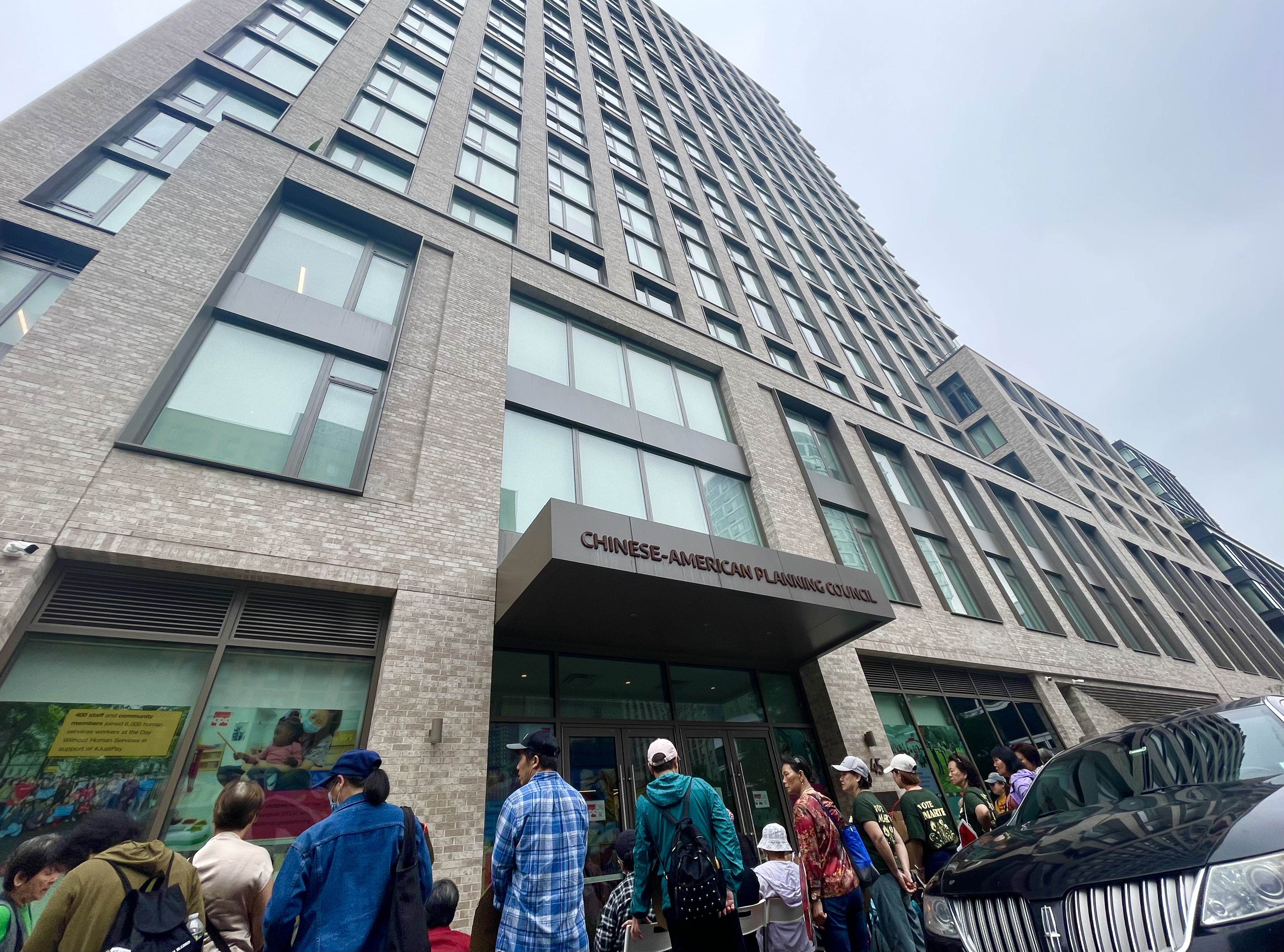
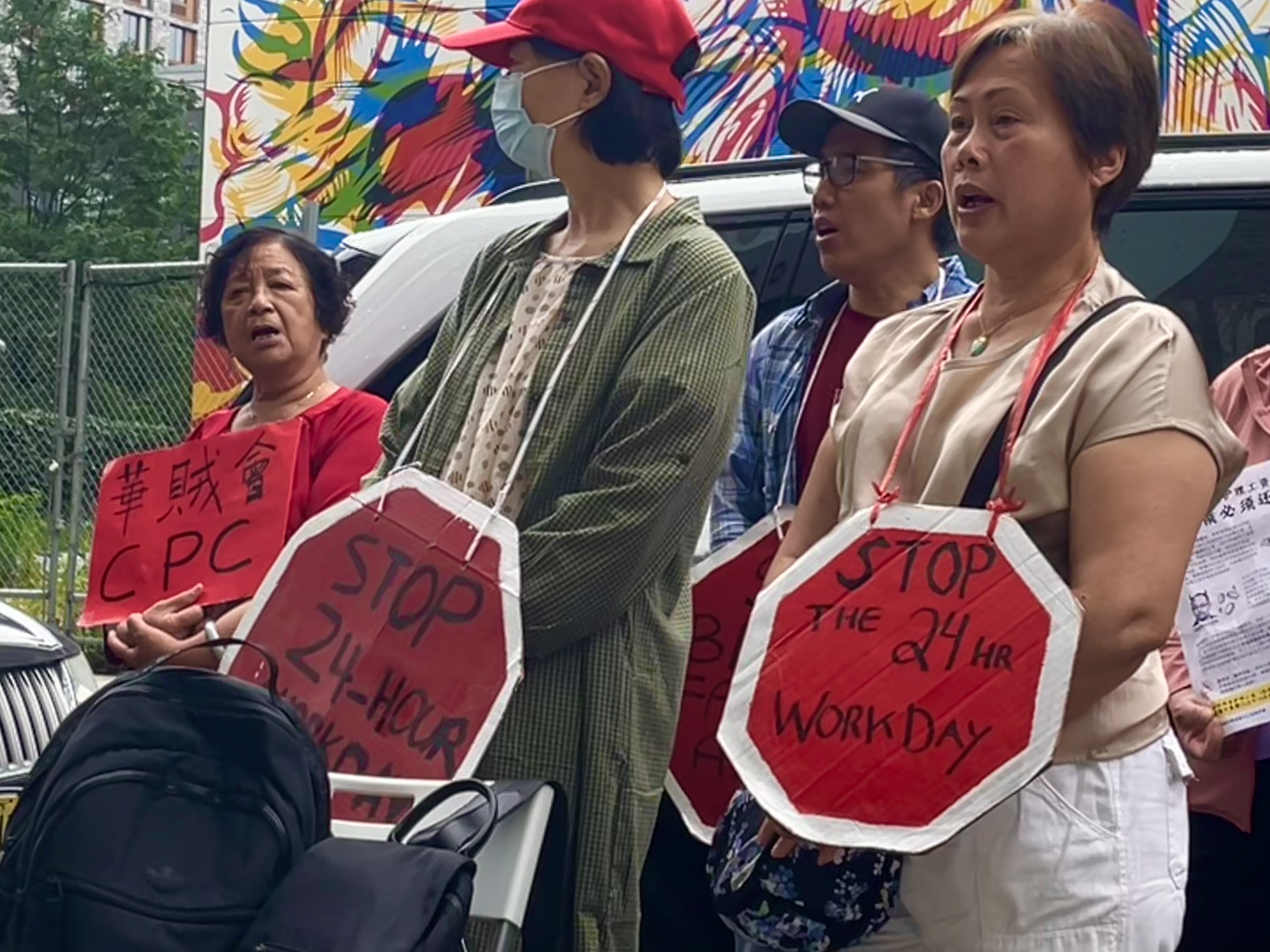
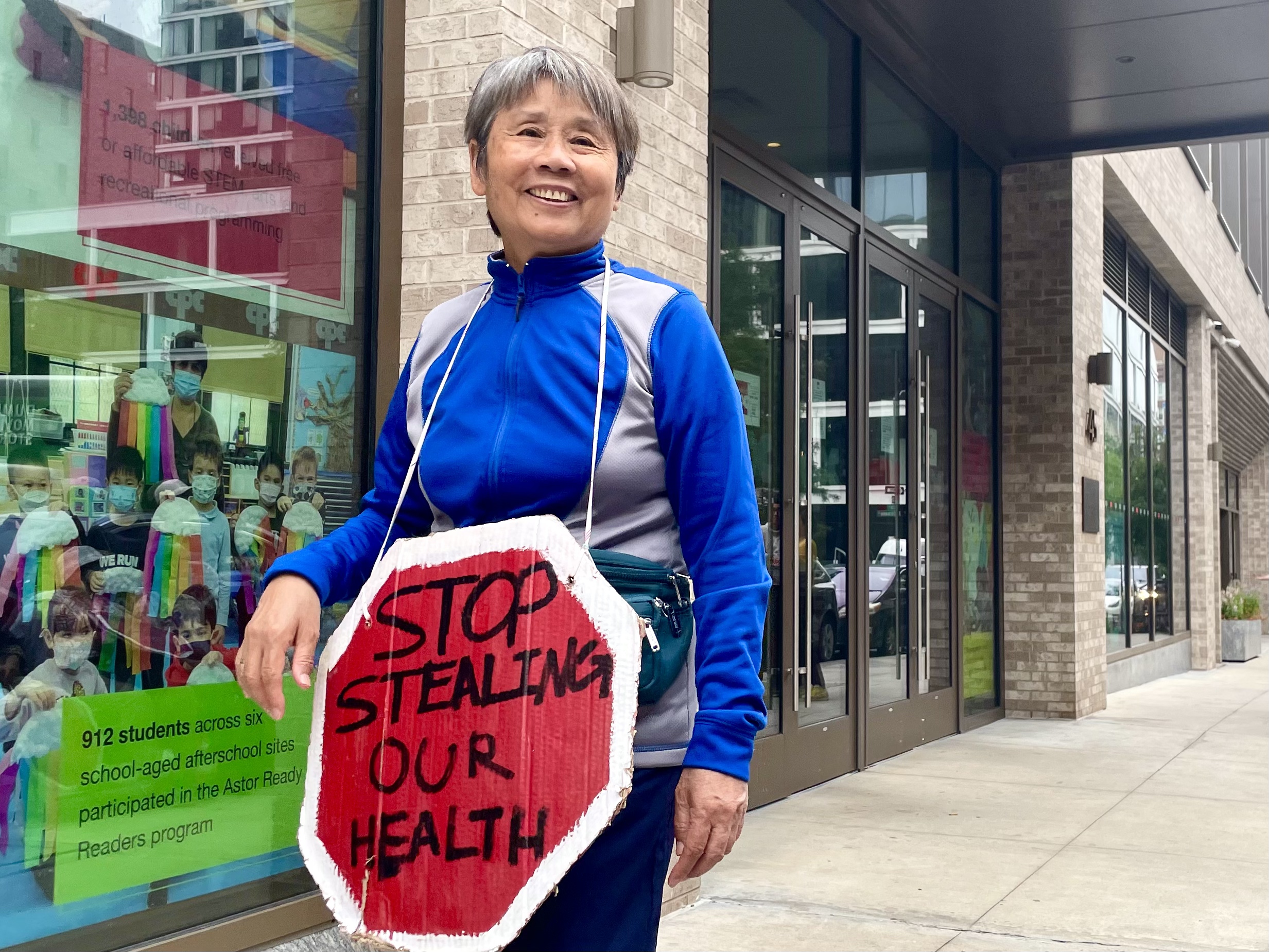
Despite CPC’s mission to “promote the social and economic empowerment” of Asian American communities, they have played a role in enforcing 24-hour workdays for home care workers with only 13 hours of pay. Protestors complain that the “stolen” wages of 11 hours a day, now amounting to over $90 million in lost wages, have been used to build the 30-storey luxury tower in Manhattan that they now hold signs in front of.
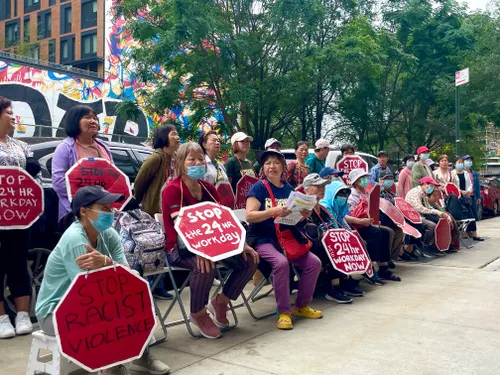
Protesters gather outside the new headquarters of the Chinese-American Planning Council in Manhattan, New York City, June 18, 2025. Construction began in 2022 and was completed in 2024, according to Yolanda Zhang, an advocate with Ain’t I a Woman?! (Zhenjia Zhang/The Xylom)
“This building was built with our blood and sweat,” said Liyi Chen, who worked as a home care worker for 22 years before retiring.
Currently, 80 workers are assigned to 39 cases that require 24-hour shifts, while 152 workers are assigned to 38 cases that require 12-hour split shifts, according to a statement made by CPC on Mar. 5, in response to a protest outside the CPC’s 60th Anniversary Galaevent that took place on Wall Street.
According to the New York State Department of Labor, 24-hour shifts require compensation for only 13 hours of work, provided the aide is afforded 8 hours for sleep (with at least 5 hours of uninterrupted sleep) and 3 hours for meal breaks. However, in practice, home care workers say they don’t get any time of uninterrupted rest.
Subscribe to The Xylom’s Free Newsletters
Get more updates on the world’s most pressing health and environmental disparities.
No spam. Unsubscribe any time.
“I had to get up every hour at night, they get up frequently to go to the bathroom or drink water, so I couldn’t sleep at all,” said Yali Le, a retired home care worker. “There was even a bell installed next to my bed, and I jumped up when the bell rang, which made me neurasthenic; my body couldn’t take it anymore.”
“This has truly destroyed our lives,” Le said. She now suffers from chronic pain from the lack of afforded rest during her home care days. “The pain is indescribable.”
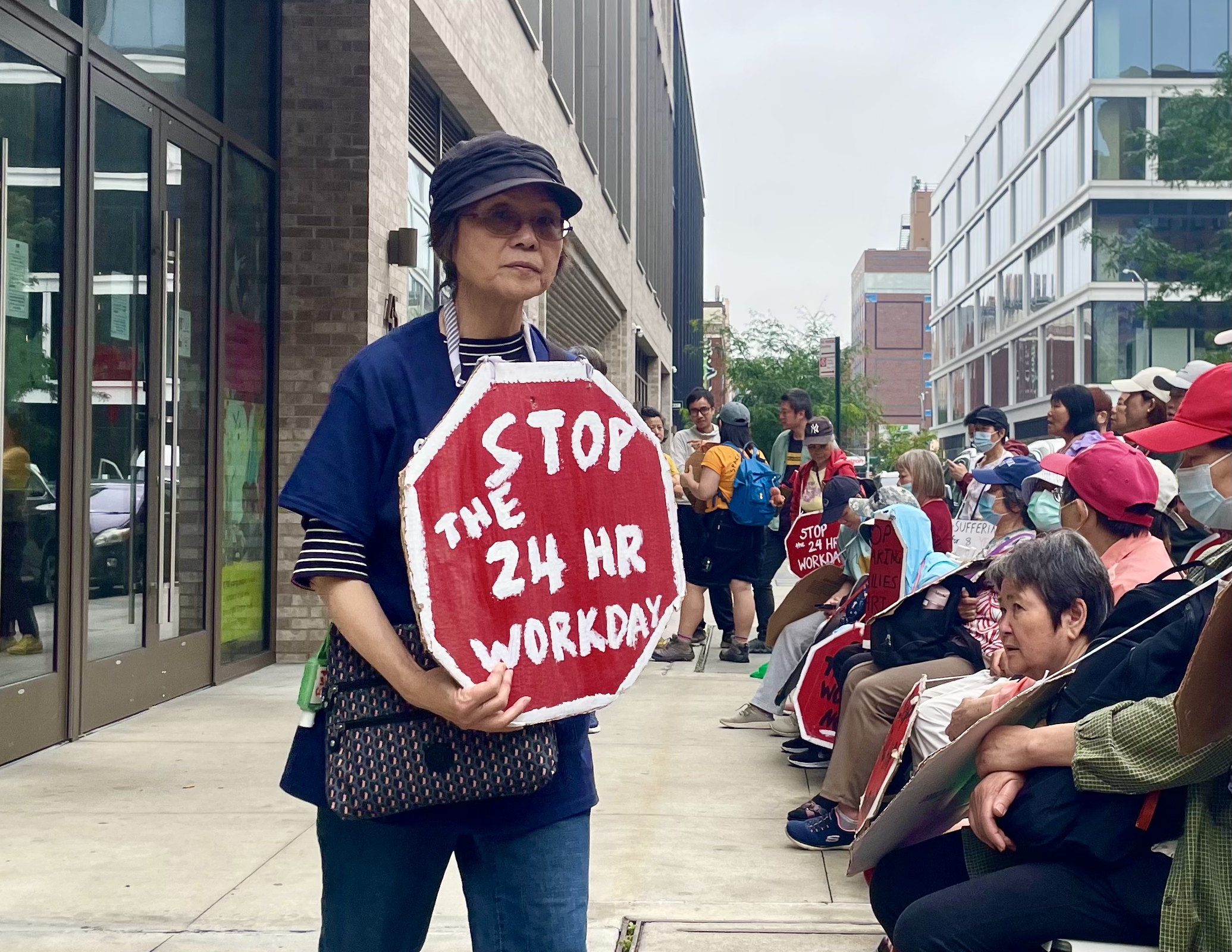
Yali Le, a retired home care worker with more than a decade of experience, protests outside the Chinese-American Planning Council building in Manhattan, New York City, on June 18th, 2025. (Zhenjia Zhang/The Xylom)
Several home care workers share similar stories of chronic illnesses as a result of the long hours at work.
“I have long-term headaches and insomnia, and I would suddenly wake up when I was sleeping at my own home, wondering if it was my patient calling me,” Chen said.
In its March 2025 statement, CPC declared that while they fully support home care workers in their efforts to stop the 24-hour workday, those shifts are mandated by state law and determined by insurance companies. Therefore, “CPC does not have the power to split 24-hour shifts on our own and has been advocating for State reform for years, alongside our advocacy for Fair Pay for Home Care.”
“On the one hand, they use that money to build a luxury building, and on the other hand, there’s nothing they can do,” said Zishun Ning, an advocate affiliated with Ain’t I a Woman?!, a coalition that started the movement to end the 24-hour workday. “But they won’t stop sucking workers’ blood.”
Until state laws are changed, there are not too many choices for workers but to work 24-hour shifts.
Home care workers protest outside the Chinese-American Planning Council building every Wednesday. One protester brought a Chinese sign accusing the CPC as the "Chinese Pirate Council". (Zhenjia Zhang/The Xylom)
"If we don’t, they say there’s no work for us,” said Yuying Lin, who has been a home care worker for more than 10 years. “We rely on this job to make a living."
Home care workers also face consequences if they refuse to work 24-hour shifts. “They punish you, they’ll assign you to a patient who lives far away, it takes three hours just to get there,” said Yolanda Zhang, an advocate affiliated with Ain’t I a Woman?!
Home care workers’ allegations against CPC go back years. In 2021, an explosive 103-page report released by David Lee, legislative director of New York State Assemblyman Ron Kim, alleged that the CPC was engaging in rampant wage theft and abusing Chinese immigrant home care workers using a prolonged forced-arbitration scheme, which the home care workers were asked to sign away their right to sue without told how much they will be paid, blocking them from getting justice in court.
“CPC and the 1199SEIU colluded to trick the workers into signing an unequal arbitration agreement, and asked the union to modify the union contract to protect its interests,” said Zhang. “90 million is just a conservative number and calculated based on the average working hours of 24-hour workers in the past 6 years.”
While the Department of Labor enforces wage laws, the Department of Health manages reimbursements for the agencies that employ home care workers. Without simultaneous reform of both systems, workers will not be able to get an increase in wages.
New York City Council member Christopher Marte has introduced a bill to ban 24-hour shifts entirely and instead require 12-hour split-shifts. However, City Council speaker Adrienne Adams, who finished fourth in June's New York City Democratic Mayoral primary election, has refused to support the bill, saying that the law can only be changed at the state level.
Seven Democratic primary candidates — Adrienne Adams, Andrew Cuomo, Brad Lander, Zohran Mamdani, Zellnor Myrie, Scott Stringer, and Whitney Tilson (from left) take the stage at the final mayoral debate on June 12, 2025, at the Gerald W. Lynch Theater in Manhattan, New York. (Zhenjia Zhang/The Xylom)
When The Xylom reached out to CPC for comment, their communications director, Alice Du, emphasized that the organization wants to split 24-hour shifts, but current state regulations and insurance reimbursement rules limit their ability to change the rule independently.
“If CPC’s Home Attendant Program could split 24-hour cases on our own, why wouldn’t we?” said Du. “It would be better for the organization, workers, and clients.”
However, home care workers don’t think this is enough. “They act like they’re being generous to them, to me, they look down on women,” Ning said. ”They say Chinese people just want to be slaves, that we’re willing to work 24 hours straight.”
The Xylom's reporting is supported by hundreds of readers like you. Becoming an annual or monthly member is the best way to help us maintain a steady source of revenue that supports investigations that span months, if not years. Cancel anytime.
Several immigrant communities across New York City are suffering due to the 24-hour shifts.
“It’s not just a Chinese issue, a white issue, a black issue, a brown issue,” said Tej Budhram, who works at the Flushing Workers Center, an organization that fights for better conditions for workers. “It’s truly affecting all workers, but specifically women of color.”
But these workers do not plan to stop the protests until they get the justice and the change they deserve.
Liyi Chen, a retired home care worker with 22 years of experience, protests outside the Chinese-American Planning Council building in Manhattan, New York City, on June 18th, 2025. (Zhenjia Zhang/The Xylom)
“We come together every Wednesday to protest,” Chen said. “To release the pain of 24-hour work, to find strength in unity, and to demand justice.”
‘They Won’t Stop Sucking Workers’ Blood’: New York Home Care Workers Demand End to 24-Hour Shifts